
The real cost of leaving candidates guessing

Recruitment is relational.
There are many non negotiables in a healthy relationship including respect, trust and open communication. Perhaps equally important is empathy — understanding the thoughts, feelings and experiences of the other person.
For leaders and employers, this is about understanding what your employees — and candidates want and need.
This is where hiring teams can learn from our friends in marketing — because recruitment is a marketing challenge.
Insights are the building blocks of effective marketing. Armed with the right insights, marketers can better understand their audience’s needs, wants and desires and create a more compelling customer value proposition (CVP).
The same is true for hiring teams. When you seek to understand what people want, expect and need; you’re better equipped to articulate and leverage the value you offer to your people (your employee value proposition).
In recruitment, the person you’re trying to attract is the consumer.
The job you want them to choose (and keep) is the product.
Consumers look for information that helps them make decisions. They want to understand what’s on offer, how the job will feel and whether it’s right for them. When that information is missing, the experience quickly shifts.
Here's what that looks like from the candidate's perspective.
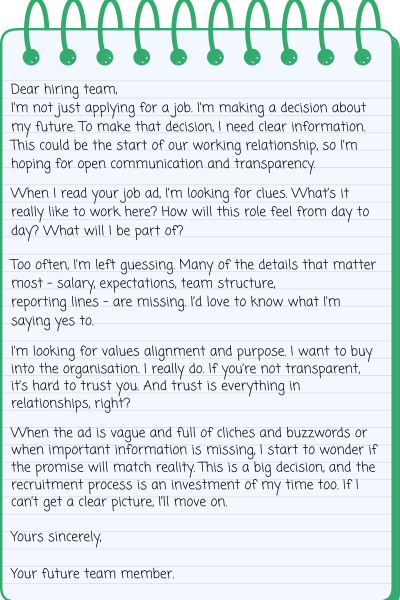
Real comments from candidate research
There is a lot we can do better in how we hire.
Clearer, more comprehensive recruitment content is a great place to start.
Lack of clarity and transparency not only sends the wrong message, it could cost you great candidates.
When people don’t have enough information to assess whether a role is right for them, they won’t opt in to your process. Or you’ll both invest time in an interview process only to find you’re not aligned. Candidates drop out, accept other offers, or worse — accept the job only to find it’s not the right role for them.
A 2024 survey found 40 percent of people who left a new job in the first 12 months did so because of a mismatch between the role advertised and the realities of the role.
This is not about the quality of the evaluation and selection process. This is a communication problem.
Clear, honest, audience-focused messaging is not a nice to have — it’s fundamental to attracting the right people.
This is a core theme in the book Attract: Recruitment Reimagined.
It's also one of the key areas we cover in our new recruitment mentoring program.
Through this program, we’re supporting organisations to bring marketing and consumer-thinking to their hiring approach, communicate more clearly, build trust and ultimately hire better.
We are deeply committed to making recruitment easier for nonprofit leaders.
Curious to know more? Get in touch for a chat.